The TRUTH about PROFITABLE TRADING!

Don't let this 'Plain Jane' looking website fool you. If you are looking for a pretty website with all the bells and whistles that doesn't do anything more than fill your head with worthless garbage, then you are in the wrong place. The pretty websites are designed to sell you something. I should know, I have several such sites, such as the one listed somewhere on this site if you care to visit. Am I putting those sites down or saying they don't offer anything of value. Of course not! Are you kidding? The pretty site I operate has been doing business since 1996 with many happy clients. It offers a GREAT service. The thing is, the service is not free and nor should it be. It's worth many, many times what is being charged. However, THIS SITE IS FREE and so you can't expect me to make it all nice and pretty, right?

All right then, let's get down to the nuts and bolts of it, shall we?

I'm going to share with you the very knowledge you need to become a profitable trader. Sure you can learn a ton more stuff that might give you an edge here or there, but then you're just going to get suffer from information overload. The information on this site is just going to be cut and dry. Okay, hopefully not dry. :-)

Tip #1:

Trading is profitable. Very profitable. You betcha! I've been doing this since 1989 and can't see myself doing anything else. It has taken really good care of us once the ins and outs were ironed out years ago. And you know what? It's only as difficult as you make it. But while you certainly can make a lot of money trading, you can lose a lot also. In fact, even if you are a profitable trader, you are going to take losses anyway. That's just how it is. If you think you are going to be a successful trader and not take on losses, then you would be fooling yourself. So get it into your head right now. You are going to lose trades and lots of trades for as long as you are a trader. That's a fact. So once you get that into your head, you can start to view losses as nothing more than part of the profit making process and not let it get your panties in a wad.

Tip #2:

Trading with the trend is your best option. No doubt about it. It may sound cliche' to say "The Trend is Your Friend", but it goes as far back as with W. D. Gann in the early 1990's who pounded this fact into traders heads back then. If you want to be a profitable trader, do not even think about fighting the trend. There are forces behind market price movement of varying scales at work. We call them CYCLES. When prices are in motion in one direction, they are likely to continue in that direction for a good period. Oh, you probably are thinking about the ups and downs of the daily or hourly chart and shaking your head about prices "continuing in one direction for a good period" as nothing more than hooey. Don't be so narrow focused. While your daily chart is zigging and zagging this way and that, the longer-term trends are well established on one direction or the other. Be sure you know what direction that is and stick in that direction on your lower time-frame charts.

Just take a look at the MONTHLY chart of the Australian Dollar shown above. This is just to give you and example of how long a signficant trend can last. While you are not likely to catch any of these from the exact start to finish, the good news is that you do not have to in order to make profits. The KEY here is to simply LOOK at the current long-term chart and note which direction it has been moving overall. Later on you will learn some simple drawing techniques to help you gauge when prices may be changing direction.

Tip #3:

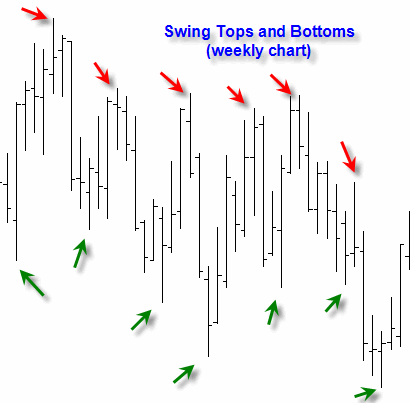
The Trend Indicator, originally taught by W. D. Gann, is a VERY IMPORTANT tool to learn. It surprises me how most traders never bother to apply this simple indicator. Another name for it is the SWING INDICATOR. The deal is this: Markets travel in waves. No surprises there, right? These waves are made up of price swings that tend to form a ladder-like pattern. For instance, a bullish trend is made up of higher swing top and higher swing bottoms, where a bearish trend is made up of lower swing top and lower swing bottoms. All you need to do is to note if the market is making higher or lower swings to determine whether you should be buying the higher swing bottoms or selling the lower swing tops.

Above is a daily chart of the Australian Dollar. Yes, I know, I'm using the same market as my last example. The reason is that I just happen to have it up on my screen. Give a guy a break, eh? :-) I could use any market to show you the same example, so if you like, call it a daily chart of Alaskan Butter (yep. I made that one up so don't go asking your broker about trading it.)

The SWINGS are called ONE-BAR swings. Why? Because it only required a single higher-high or lower low to move the line to the next bar and so-forth. If I was plotting TWO-BAR swings, I would have to wait until I got a second higher high price before moving my line up to that high, or a second lower-low price before moving my line down to the low. The procedure is taught in some W. D. Gann books (or Gann-type books) and is also taught in my Professional Trading Techniques eBook found at http://www.amazingaccuracy.com. Yes, it's a shameless plug, but I did warn you earlier that a link is provided to my site.

If you use the next higher-time frame from the one you are using to trade to get the overall trend, you can then use the time-frame you trade with to add this Trend Indicator technique. For example, if you usually trade off the DAILY price chart, use the WEEKLY price chart first to determine the trend. It's just a matter of looking at the chart and nothing which way it is moving 'overall'. Then on the DAILY chart, plot your Trend Indicator lines and note the type of swings. So if the WEEKLY is bullish, you want to trade the daily chart as it is making higher swing tops and higher swing bottoms, where you enter off the higher swing bottoms (dips).

Tip #4

The TREND LINE is a very handy and simple tool to use for trading profitably. Most traders know this tool and perhaps even use it. But most do not use it effectively enough. If you are following the Tips listed earlier, then you are on your way to using the TREND LINE as it is best used.

Above is a daily chart of Soybeans. Yippee, a different market! See, I can mixed it up with the best of 'em. There are several lines on this chart, so I'm going to try to sort it all out for you so that you can get the jist of what is going on here. Starting from the top, price is dropping. You have already looked at your WEEKLY chart and have determined that it is bearish, so you would like to trade off lower swing tops on the DAILY chart. You see a lower swing top confirm when the next price bar makes a lower low (pointed to by blue arrow closest to the top). Supposing you enter this market short at this time, you may have placed your stop-loss above the new lower swing top high for now. A second lower low price bar follows your newly confirmed lower swing top (second blue arrow from top). Now is a good time to place a trend line (A) across your two swing tops and use this as your stop-loss and trend change reference line. You can start moving your stop-loss down by just placing it above this line by a few ticks along the way.

Shortly after going short, another lower swing top confirms. We could immediately draw trend line (B) if we want because price has moved well below the last swing bottom low only after one lower low price bar (third blue arrow from top marks this one lower low price bar). Or, you can stick to the simple 2-bar rule used previously. Either way, we draw (B) and now have a new stop-loss/trend change line drawn. Our third lower swing top confirms. However, only one lower low price bar follows this third lower swing top and did not move down enough below the previous swing bottom to justify drawing trend line (C). However, prices rise again and a forth lower swing top is confirmed. After two lower-low price bars formed, we can now draw trend line (C) off the previous trend line lower swing top and the newly confirmed lower swing top. Eventually price rises again after making bottom and crosses above our stop-loss/trend change trend line (C). We would be out of the trade now.

Shortly after exiting the market, we get a new higher swing bottom. We're not looking to trade these because the weekly trend is bearish as was stated earlier. Yet, you are monitoring the market and just keeping track. When two higher-high price bars follow that new higher swing bottom, you can now draw trend line (D). Note that when it finally breaks, it does so following a new lower swing top that is tradeable for our bearish outlook and the whole procedure starts again.

It is DEFINITELY WORTH practicing drawing trend lines off swing tops and bottoms for the market you like to trade. This will help you get a feel for what to expect.


Tip #5

It is very important to solve for support and resistance in order to further note whether the probability of success is on your side before you take a trade. It is said that the 50% rule can make you rich. Perhaps, but I have seen this market cross that 50% mark more times than it respects it. If you really want a better way to gauge support and resistance, you should apply BOTH static and dynamic Fibonacci to your price charts using the previous price ranges.

For the STATIC FIBONACCI, it is as simple of taking the most recent price range and calculating the retracement of 38%, 50% and 62%. My charting program adds a couple more and yours probably does as well. But the three here mentioned are the ones you really want to keep note of.

The daily chart above is the same as shown earlier on daily Soybeans. Note that prices are dropping from point A to point B. For STATIC Fibonacci, you simply take the range of A to B and multiply this by the Fibonacci ratios of 23.6, 38.2, 50, 61.8, etc. (see ratios on the chart above). These results are simply added to the price at B to get the resistance levels you see on this chart. As can be seen on this chart, the new lower swing top has confirmed below 61.8% resistance. It didn't quite reach that level though, which might make you wonder if it did you any good. Ah, but have no fear, for Dynamic Fibonacci is also near!

The next example shown above has Dynamic Fibonacci ratios applied. Here, you need three points to apply this technique. If you are figuring for resistance (price is rising off a new swing bottom), you will look for an upside-down V formation as labeled above as A-B-C. If price happens to be moving lower from a new swing top, you would look for a regular V formation, where A would be a top, B would be a bottom, and C would be the top that price is moving down from.

Notice that our new lower swing top high is right there at the green line. This green line is the 38.2% Fibonacci ratio. The same ratios are used here for the Dynamic as was used for the Static. However, it is drawn this way: First, find your A-B-C formation (usually the most recent or prominent top-bottom-top or bottom-top-bottom pattern). For prices rising off a newly confirmed swing bottom, you want the bottom-top-bottom (upside down V) formation. For prices moving lower from a newly confirmed swing top, you want the top-bottom-top (V) formation.

Take the range of (B to C) and multiply this range by the ratios just like you did with the Static to get your values. Add these values to C for the upside-down formation, or to B for the regular V formation. Now, you need to draw a line from B extreme to C extreme (in this case, the high of B to the low of C) and then plot your results on this line with a small dot or mark. Now, draw your ratio lines from the A extreme (the low of A in this example) through each of those ratio points out into the future. Those are your dynamic levels.

Above chart shows how I have drawn a line from B to C and then divided that line by the ratios. These divisions are marked by the red dots. Then from point A I can draw my lines through each dot into the future to get the correct dynamic ratios.

There are various useful techniques for solving support and resistance. These are two of those techniques. It is always good to QUALIFY your swings as being at support or resistance BEFORE you contemplate taking any trade based on that swing. That is why I mention it. :-b


Tip #6

This is a big one. And if you are like most traders, you will ignore this and push forward to your own detriment. Money Management. I know, it is that yucky MM word again. But hey, do you want to be profitable or don't you?

The bottom line is that you are GOING TO TAKE LOSSES as part of your trading career. What will keep you on the PROFITABLE side of the equation, assuming you follow the tips already provided above, is that you do not over-trade for the size of your account. There are many theories on what percentage of account is best to risk per trade. W. D. Gann suggested 10%. However, you must either know how to trade like W. D. Gann or being using my service at http://www.amazingaccuracy.com to trade with really good precision if you are going to risk that much of your account on any single trade. Outside of such precision, you should not risk more than 3% of your account on any single trade. This will allow you to take losses and remain in the business long enough to make much more than you have lost if you execute your trades as suggested.


SUMMARY

It is very important that you do not let your emotions come into play. All traders take on losses. That is just the way it is. Get over it. Once you can accept this without getting bent out of shape each time a loss occurs, you're on your way. You need to first determine the trend by looking at the chart that is one time frame above the time frame you are going to trade from. So for those who trade off the DAILY chart, use the WEEKLY chart to first determine the overall trend.

Once you have a good idea as to the overall market direction, stick to your guns to only trade in that direction on the daily chart. This means you need to start drawing your SWINGS. Once you do that, you can quickly see whether the chart is producing swings that are in harmony with the trend of the higher time frame. If bullish, buy off higher swing bottoms and if bearish sell off lower swing tops.

Use this SWINGS to draw your trend lines. These lines are your stop-loss and trend-change lines. Resolve to use two swings to draw your lines where the second swing has been confirmed by at least two higher-high or lower-low price bars. For swing tops, two lower-low following. For swing bottoms, two higher-high following. They do not have to form consecutively, but are accumulative. Once you have this, draw your line. Draw a new line only when a new lower swing top (bear trends) or higher swing bottom (bull trends) forms based on the two confirming bars. Note: You only need one bar rather than two to decide whether to draw the new line if that one bar moves well beyond the previous swing. So if prices are dropping, for example, and a new lower swing top confirms, if the bar confirming it moves well below the previous swing bottom low, that's good enough to draw a new trend line.

When deciding whether to sell below a new lower swing top or buy above a new higher swing bottom, it is best to note whether the new swing is at support or resistance. If it is not, you have the risk that the swing will not hold but be exceeded by yet a new high/low. So by solving for support/resistance, you strenghen your position and also know you have a good place to put your initial stop-loss until you are able to draw your trend line later in order to move your stop with the trade.

And finally, do not overtrade!

May you find success!

ProfitMax Trading Inc.
http://www.amazingaccuracy.com